Kept Through the Fire
A Covenant Response to Fade to Black
On the rise of global tyranny, the last trumpet, and the hope the church was actually given
·
In a recent conference conversation, teacher J.B. Hickson introduced his new book, Fade to Black: Rise of Global Tyranny, and walked through what he calls the seven spirits of the Antichrist — deceit, power, perversion, and the rest — and how each one seems to be gathering strength before our eyes. Surveillance that never sleeps. An economy inching toward the day when a man cannot buy or sell without permission. A culture calling darkness light. A church that can barely remember whether it believes in an unseen enemy at all.
I want to say plainly, before anything else, that much of what he sees, he sees rightly. What follows is commentary, not a takedown. Brother Hickson loves the Lord, loves the lost, and is trying to wake a drowsy people. On a great deal, he and the Scriptures are agreed, and so am I. The disagreement I mean to raise is not about the darkness of the hour. It is about one question that quietly reorders everything else.
Section IWhere He Is Right, He Is Right
The unseen realm is real. Paul told the Ephesians we do not wrestle against flesh and blood but against principalities and powers, against spiritual forces in the heavenly places. When Hickson insists that the strange things filling our skies and our headlines are not visitors from some distant planet but a manifestation of that darker realm, he stands closer to the Bible than the church that has quietly stopped believing in an enemy at all. A people who have forgotten the devil have also forgotten why they were handed armor.
His word on perversion is worth keeping too. In Scripture, to pervert is not first a matter of the body — it is to take God's good design and turn it upside down, to call evil good and good evil, to trade the light for the dark. And when he says the image of God in humanity is male and female, and that erasing those categories is an assault on that image, he has the first chapter of Genesis behind him.
He is right, finally, about the state of the house. A church that no longer expects to fight is a church that has already been disarmed. Whatever else you take from his warning, take that. So when I turn now to where I must part ways with him, understand that I am not disputing the darkness. I am disputing the map.
Section IIThe One Question That Reorders the Rest
Almost every load-bearing pillar in Fade to Black rests on the same foundation: that a single man of sin will step onto the stage only after the church has been secretly caught away, that a future seven-year period — Daniel's seventieth week — still waits to run its clock, and that the Antichrist will strike his covenant and set up the abomination at the midpoint of that future seven years.
I understand why so many godly people believe this. It was handed to them by teachers who loved the Lord, in study Bibles they trusted, inside a system barely two hundred years old but now assumed to be the plain reading. I hold no contempt for anyone who received it in good faith. But I would ask one gentle question, and I would ask it of the ninth chapter of Daniel.
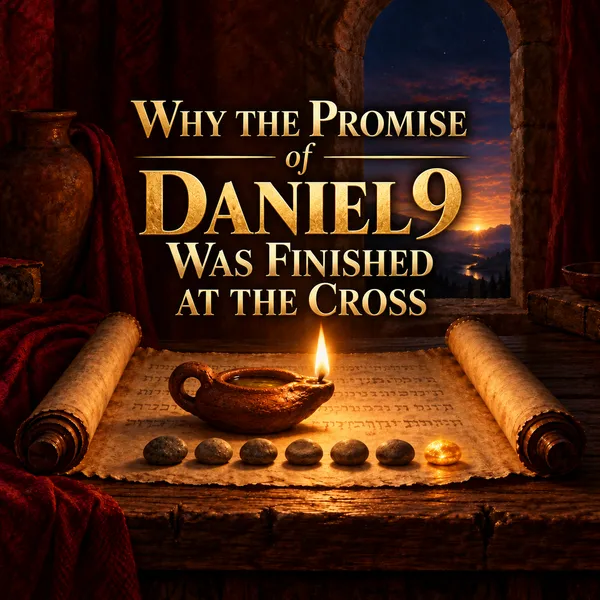
The angel Gabriel told Daniel that seventy sevens were decreed — and then he named their purpose.
Read that list slowly. It is not a catalog of things a future tyrant will do. It is a catalog of things the Messiah has already done. Every single one was accomplished by Jesus — Yeshua, whose very name means Yahweh saves — in His own ministry, at His own cross, and in the pouring out of the Holy Spirit that followed. To finish transgression, to make an end of sins, to bring in an everlasting righteousness that can never be revoked: this is the language of Calvary, not of a coming treaty.
And when Gabriel says that "in the middle of the seven" the sacrifice and offering would cease, the Gospels answer him. At the death of the Lord the veil of the temple was torn from top to bottom — torn from heaven's side, not from man's — and the whole machinery of blood and altar was finished forever. The covenant "confirmed with many" is not a pact a future Antichrist will sign with Israel. It is the New Covenant sealed in the blood of the Lamb.
Here is why this matters so much. If Daniel's seventy sevens were completed by the Lord Himself, then there is no leftover seven-year clock hanging in the future waiting to be started. And if there is no leftover clock, the entire architecture of a post-rapture Antichrist confirming a covenant at the midpoint of a coming tribulation has no floor beneath it. The stage everyone is watching being "set" was, in truth, already occupied — by the Bridegroom, two thousand years ago.
The decisive act is not out ahead of us, waiting on a tyrant. It is behind us — finished at a cross and sealed at Pentecost.
Ten Words Press
Section IIIKept Through the Fire, Not Snatched Before It
The other great pillar is the secret rapture — the hope that the church will be lifted out before any of the trouble falls. Hickson holds it warmly, as most of the modern church does, and he says we will be rescued when the trumpet sounds.
I love that he reaches for a trumpet, because Scripture hands him one. But it hands him the last one. Paul says we will all be changed, in a moment, in the twinkling of an eye, at the last trumpet. He tells the Thessalonians the Lord Himself will descend with a shout, with the voice of an archangel, and with the trumpet of God. And John tells us that when the seventh and final trumpet sounds, the kingdoms of this world become the Kingdom of our Lord, and the time of the dead has come to be raised.
One event. Three witnesses. The last trumpet is the seventh trumpet is the trumpet of God. The gathering of the Bride — God's one covenant people, the believing remnant of Israel together with every soul from the nations brought near in Christ — happens there, at the end, not before the beginning.
So what becomes of the Bride in the meantime? She is not extracted. She is kept. When the sixth seal shakes the heavens, an angel cries out with a command that changes the whole picture.
Sealed — and then kept through what follows. This is the oldest pattern in the book. Israel was not carried out of Egypt before the plagues fell; Israel was marked with the blood on the doorpost and kept safe through them while judgment passed by. That is the covenant shape of deliverance: not evacuation, but preservation. The lamb's blood on the door, and the family safe inside while the night does its work.
Even Paul's comfort that we are "not appointed to wrath" points to the final bowls — the seven last plagues in which the wrath of God is complete — not to the whole of history, and not to a tribulation the Bride must be spirited away to avoid. She is sealed for the road, kept on the road, and gathered home at the last trumpet. That is a sturdier hope than a secret exit, because it does not depend on the timing being convenient. It depends on the blood on the door.
Section IVA Word About Israel and the Fig Tree
Hickson, like many, reads the rebirth of the modern state of Israel in 1948 as the great prophetic domino — the budding fig tree that starts the countdown. I would only ask readers to hold that reading loosely, and to read Luke carefully. When the Lord pointed to the fig tree, He said, "Look at the fig tree, and all the trees" — which quietly undoes the idea that the fig tree is a secret code for one nation and one calendar year.
The regathering the prophets longed for is a work of the Spirit, ending with a people who look on the One they pierced, and mourn, and are grafted back into their own olive tree. That is God's doing, by His own breath, in His own hour. It is far greater than a vote at the United Nations, and far more sure. To pin the Lord's return to an anniversary is to keep resetting a clock that Scripture never set — and the church has already watched that clock be reset more than once. Eighty years is long enough to expose a false prophecy and a broken deadline.
Section VThe Movie Has Not Faded
The book's title imagines the screen going dark and the credits rolling — with the real story only now beginning. I would offer a different picture, and I believe a truer one. The screen has not faded to black. The dawn has already broken. The decisive act is not out ahead of us, waiting on a tyrant; it is behind us, finished at a cross and sealed at Pentecost, and it is being carried forward now by a people the enemy cannot touch without permission.
Yes, the four horsemen are riding. Conquest and war and famine and death have marked this whole age since the Lord's first coming, and they ride still. Yes, the martyrs beneath the altar are still crying, "How long?" We do live in serious days. But the church does not wait for rescue like a passenger hoping the boat leaves before the storm. She stands sealed in the storm — a lamp in the dark — until the last trumpet sounds and the Bridegroom comes for His Bride.
That is not a smaller hope than the one Fade to Black offers. It is a larger one. It asks the church not to watch for an exit, but to stand — armored, awake, and unafraid — because the One who kept Israel through Egypt keeps His people still.
Look up. Not because the movie is ending. Because the Bridegroom is coming, and He has never once lost anyone the Father gave Him.
This is a work of theological commentary and criticism responding to a publicly released interview and book, Fade to Black: Rise of Global Tyranny by J.B. Hickson (Not By Works Ministries). It is offered in the spirit of Proverbs 27:17 — iron sharpening iron — and with respect for a brother who teaches in good faith. The positions summarized here are paraphrased for the purpose of response and analysis; readers are encouraged to engage the original directly and to weigh all things against Scripture (Acts 17:11).
Fair Use Statement
This commentary references and characterizes the ideas of a copyrighted work for the purposes of criticism, comment, and teaching. Such use is believed to constitute fair use under Section 107 of the U.S. Copyright Act, which permits limited use of copyrighted material for commentary and criticism. No substantial portion of the original text is reproduced. All rights to the original interview and book remain with their respective author and publisher. This response is independent and is not affiliated with, endorsed by, or produced in cooperation with the original author.
Watch the Original Conversation
https://www.youtube.com/watch?v=NJ1F43oWf8M

Comments
No comments yet. Be the first.