The Cup at the Door
The Second Circuit, the Sabbath of the Tenth, and the Lamb Kept in the House
From a green barley field to the hour between the evenings — every son of Israel carried what he loved to the slaughter, until the Son carried Himself
·
Begin with the assumption that Messiah died on a Friday and rose on Sunday morning, and everything else must be arranged to fit: the entry becomes "Palm Sunday," the anointing at Bethany floats loose in the week, the "three days and three nights" of the sign of Jonah (Matthew 12:40) is compressed into a day and a half, and the tenth of Aviv — the day Yahweh commanded that the Passover lamb be taken into the house — vanishes from the story altogether.
Begin instead where the Canon begins, and hold the one chronological anchor Messiah Himself gave — "as Jonah was three days and three nights in the belly of the great fish, so will the Son of Man be three days and three nights in the heart of the earth" — and the Crucifixion falls on Wednesday, Aviv 14, in the midst of the week. Once the fourteenth is fixed to Wednesday, every preceding day locks into place: the ninth of Aviv falls on Friday, the tenth on the weekly Sabbath, the eleventh on the first day of the week. What follows is the story of how the Lamb arrived — and why He arrived exactly when He did.
Section IThe Month the Calendar Added
The story of the final approach to Jerusalem begins not in Judea but in the barley fields.
Israel's year was not fixed by arithmetic. The first month is Aviv — the month of the ripening ear — and the name is a condition, not merely a label. Deuteronomy 16:1 commands: "Observe the month of Aviv, and keep the Passover to Yahweh your Elohim." For Passover to be kept lawfully, the barley had to be aviv — ripe enough in the ear that the firstfruits sheaf could be waved before Yahweh during the feast (Leviticus 23:10–11). At the end of the twelfth month, the fields were examined. If the barley stood green and soft, the new year could not begin; a thirteenth month — a second Adar — was intercalated, and Passover slid forward a full lunar month.
Scripture does not record the barley report for the year of Messiah's death. What Scripture records is an itinerary — and the itinerary is strange enough to demand an explanation.
By the end of John 11, Yeshua stands at the very gates of Jerusalem. He has raised Lazarus in Bethany, less than two miles from the Temple mount (John 11:18). The Sanhedrin has met and resolved that He must die (John 11:47–53). The Passover of His death is bearing down. A man on his way to a fixed appointment two miles distant does not need another journey. Yet what happens next? He withdraws — first "to the country near the wilderness, to a city called Ephraim" (John 11:54). And then Luke records something that has embarrassed harmonizers for centuries:
Read that again. On His way to Jerusalem, He passes through Samaria and Galilee — north, away from the city, back through the villages of His long ministry, before finally descending the eastern route through Perea to Jericho (Luke 18:35; 19:1) and up the ascent to Bethany. Having come to the threshold of the city, He circles the Galilee one more time.
Geographically, this makes no sense for a man racing a fixed date. Covenantally, it makes perfect sense for a man whose date had just moved. The barley was not aviv. The witnesses came back from the fields with green ears, the second Adar was declared, and Passover — the Passover, the one toward which every prior Passover since Egypt had pointed — stood thirty days further off than the twelfth month had suggested. The Bridegroom did not spend the added month waiting at the gate. He spent it the way He had spent every month of His ministry: walking, teaching, healing, gathering. One more circuit of the villages that had heard Him first. One more month of lamps burning in Galilean doorways. The second circuit is the intercalated month made visible — the shape of Adar Bet pressed into the Gospel record.
And the added month is not incidental to the larger chronology; it is load-bearing. Messiah's ministry fulfilled Daniel's seventy sevens fractally, to the day — the 490 compressed into the Bridegroom's own ministry, from the opening Passover of the first Temple cleansing (John 2:13) to the closing Passover of the Cross, one feast cycle apart, with the Cross falling "in the middle of the seven" when "He shall bring an end to sacrifice and offering" (Daniel 9:27). A common year of twelve lunar months does not carry that count. The year of His death was a pregnant year — thirteen months — and the thirteenth month was declared not by any man's design but by the state of the grain in the fields Yahweh Himself watered. The Father set the date of His Son's death by the ripening of barley. When the firstfruits sheaf was finally cut, it would be cut in the very days the true Firstfruits lay in the tomb (1 Corinthians 15:20, 23).
Section IISix Days Before the Passover: The Return
The circuit complete, the countdown began. "We are going up to Jerusalem," He told the twelve, "and all things that are written by the prophets concerning the Son of Man will be accomplished" (Luke 18:31). Down through Perea, through Jericho — Zacchaeus in his tree, blind Bartimaeus by the road — and then the long climb up the ascent of Adummim toward the Mount of Olives.
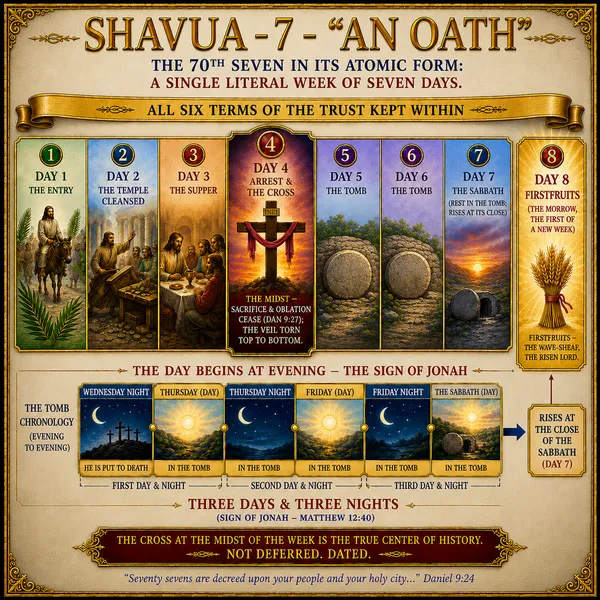
Fix the fourteenth to Wednesday and count backward. The thirteenth falls on Tuesday, the twelfth on Monday, the eleventh on Sunday, the tenth on the weekly Sabbath — and the ninth of Aviv falls on Friday, the preparation day. He arrived at Bethany late on Friday, the ninth of Aviv, as the sun leaned toward the western hills and every household in the village was finishing its Sabbath preparation.
| Aviv Date | Weekday | Event |
|---|---|---|
| Aviv 9 | Friday | Arrival at Bethany before sundown; the preparation day |
| Aviv 10 | Sabbath | The Lamb received into the household of Lazarus — selection (Exodus 12:3) |
| Aviv 11 | Sunday | Entry into Jerusalem on the colt — public presentation |
| Aviv 12–13 | Monday–Tuesday | Temple inspection: every faction examines the Lamb; no blemish found |
| Aviv 14 | Wednesday | Crucifixion in the midst of the week; burial before sundown |
| Aviv 15 | Thursday | High Sabbath — first day of Unleavened Bread (John 19:31) |
| Aviv 16 | Friday | Spices bought and prepared between the two Sabbaths (Mark 16:1; Luke 23:56) |
| Aviv 17 | Sabbath | Rest by the commandment; resurrection at the Sabbath's close — three days and three nights complete |
The timing of the arrival was not travel-weariness. It was exactitude. He arrived at the close of the ninth so that He would cross a particular threshold at a particular hour — because the next thing that had to happen was governed by a commandment given fifteen centuries earlier, on the far side of the Exodus, in the land of Egypt.
Section IIIThe Sabbath of the Tenth: The Lamb Taken Into the House
This is the ordinance the Friday tradition lost and cannot recover. The Passover lamb was not seized on the day of slaughter. It was taken on the tenth — taken into the house — and kept within the household for four days, living under the family's roof, eating from the family's hand, examined day after day until it was known beyond question to be without blemish. Only then, on the fourteenth, was it slain.
If Yeshua is the Lamb of Elohim — and John the Immerser announced Him as exactly that at the Jordan (John 1:29) — then the tenth of Aviv cannot be silent in the Passion narrative. The Lamb must be taken into the house on the tenth. And He was.
The sun set on Friday the ninth, and the Sabbath began — and with it, the tenth of Aviv. As the day turned at that sunset, Yeshua entered the home of Lazarus, Mary, and Martha, and was received into the household. The Lamb crossed the threshold as the tenth began, to the hour. "There they made Him a supper; and Martha served, but Lazarus was one of those who sat at the table with Him" (John 12:2). The table of a family that loved Him; the man He had called out of the tomb reclining at His side; the Sabbath rest of the Covenant settling over the house. The tenth-day ordinance was fulfilled not in a public spectacle but in the quiet of a home — a lamb for a household, kept within the house — exactly as the commandment was written.
Selection is the Father's private, familial act — declared at the Jordan ("This is My beloved Son"), given its Exodus form as the Lamb is taken into the household on the Sabbath of the tenth. Presentation is the public, national act — the Lamb brought out and submitted for examination at the entry on the eleventh. Two discrete movements, in sequence. Collapse them into one and the chronology breaks: an entry on the Sabbath would blemish the Lamb.
The distinction is not merely typological tidiness. It is what keeps the Lamb spotless. Bethany lies about fifteen stadia from Jerusalem (John 11:18) — nearly two miles, well beyond a Sabbath day's journey. Had Yeshua mounted a donkey on the Sabbath morning of the tenth and ridden into Jerusalem at the head of a shouting multitude cutting branches and spreading garments, the Pharisees would not have needed false witnesses at His trial. They would have had Him — a public Sabbath violation before two hundred thousand witnesses, and the Lamb blemished on the very day of His taking. The One who kept the Fourth Article of the Kingdom Constitution perfectly — Sacred Time and Covenant Rest — did not break it two miles from the finish line. He rested. On the Sabbath of the tenth of Aviv, the Lamb of Elohim kept Sabbath in the house of the man He had raised from the dead. There may be no more perfect single image in the Gospels of what the Covenant is: the Bridegroom at rest, within the household, among those His own voice had brought from death to life.
Pause here and feel the weight of what the ordinance had always asked of Israel's households. A lamb of the first year (Exodus 12:5) is not livestock in any working sense; it is young, small, and — every shepherd's child knows it — affectionate. For four days it lived inside the house, in the rooms where children slept, fed from the family's hand, following at their heels, bleating when left alone. Yahweh could have commanded that the lamb be taken the morning of the slaughter; He commanded four days. And there is no verse warning the children not to grow attached — the ordinance runs the other way. It was built to produce attachment, so that when the father carried the lamb out on the fourteenth, every member of the household felt, in miniature, what redemption costs: Israel had to slay what it had come to love. Fifteen centuries of Passovers trained the nation's heart for the sentence at the center of the Gospel — "He gave His only begotten Son" (John 3:16). The Father kept His Lamb in the house far longer than four days.
And in the house at Bethany, one member of the household carried a knowing the others did not. Martha served; Lazarus reclined; Mary, who understood most, had her flask of spikenard ready. But the Lamb Himself knew the fourteenth by name. "I have a baptism to be baptized with, and how distressed I am till it is accomplished" (Luke 12:50). Within days He would say it aloud in that very week: "Now My soul is troubled, and what shall I say — 'Father, save Me from this hour'? But for this purpose I came to this hour" (John 12:27). It was the same submission He had spoken at His selection at the Jordan, when the Immerser tried to prevent Him: "Permit it to be so now, for thus it is fitting for us to fulfill all righteousness" (Matthew 3:15). The One at rest at the Sabbath table was heavy with the knowing — and He stayed at the table.
Section IVSo Where Is the Entry? The First Day of the Week: Presentation
The Sabbath ended at sundown, and with the going out of the Sabbath the eleventh of Aviv began. The household meal at the Sabbath's close — the evening beginning the eleventh — and then John's narrative turns: "The next day a great multitude that had come to the feast, when they heard that Yeshua was coming to Jerusalem, took branches of palm trees and went out to meet Him" (John 12:12–13).
The entry into Jerusalem falls on the first day of the week — Sunday, the daylight of Aviv 11.
This is where the chronology surprises the tradition by half-agreeing with it. Palm Sunday is accidentally correct about the weekday. But notice how the tradition arrived there: not from any verse that names the day — no Gospel does — but by counting backward from an assumed Friday crucifixion. The tradition got the right day of the week from the wrong anchor, and in doing so lost everything the day means. In the Friday scheme, the Sunday entry is merely the start of the week, and Exodus 12 plays no role at all: no tenth-day taking, no household keeping, no four-day inspection. The lamb ordinance — the very pattern the Lamb came to fulfill — is simply absent.
In the Covenant chronology, the Sunday entry is the second movement of a two-part act. The Sabbath of the tenth was selection — the Father's Lamb taken into the house. The first day of the week, the eleventh, is presentation — the Lamb brought out of the household and submitted publicly, nationally, for examination. He mounted the colt at Bethphage, and as He descended the Mount of Olives the multitude of pilgrims — swollen by every witness of Lazarus's resurrection (John 12:17–18) — spread garments and branches on the road and cried the words of Psalm 118: "Hosanna! Blessed is He who comes in the name of Yahweh!" The Lamb was presented to the nation on the eleventh, and the nation received Him with the pilgrim psalm of the very feast at which He would die. "And when He had come into Jerusalem, all the city was moved, saying, 'Who is this?'" (Matthew 21:10). That is the question an inspection exists to answer.
And inspection is precisely what the next two days delivered. On Monday and Tuesday, the twelfth and thirteenth of Aviv, every faction in Israel took its turn examining the Lamb in the Temple courts: the chief priests and elders demanding His authority (Matthew 21:23), the Pharisees and Herodians with the tribute coin (22:15–22), the Sadducees with their seven-husband riddle (22:23–33), the scribe with the greatest commandment (22:34–40). Hostile examiners all, probing from every doctrinal angle Israel possessed — and "no one was able to answer Him a word, nor from that day on did anyone dare question Him anymore" (Matthew 22:46). The inspection of the Lamb closed without a blemish found. Even the certifications came from hostile and neutral mouths: Judas — "I have sinned by betraying innocent blood" (Matthew 27:4); Pilate, three times — "I find no fault in Him" (John 18:38; 19:4, 6); Pilate's wife, the thief on the stake, the centurion at the foot of the cross. Exodus 12:5 demanded a lamb without blemish, and the fourteenth of Aviv arrived with that verdict rendered by the Lamb's own enemies.
Section VDid He Stay With Lazarus? The Nights in Bethany
The Gospels answer plainly, and the answer is yes — night after night.
After the entry itself: "So Yeshua went into Jerusalem and into the temple. And when He had looked around at all things, as the hour was already late, He went out to Bethany with the twelve" (Mark 11:11). Matthew is explicit that this was lodging: "He left them and went out of the city to Bethany, and He lodged there" (Matthew 21:17). The next evening, again: "When evening had come, He went out of the city" (Mark 11:19). And Luke gives the summary pattern of the whole week:
Bethany sits on the eastern slope of that very mount. Count the nights, sunset to sunset. The night beginning the tenth — Friday night, the Sabbath night — He was received into the household. The night beginning the eleventh, after the Sabbath went out, He remained for the supper where Martha served. The night beginning the twelfth, after the entry and the late look around the Temple, He returned and lodged (Mark 11:11). The night beginning the thirteenth, after the cleansing of the Temple, He went out of the city again (Mark 11:19). Four nights, the tenth through the thirteenth, the Lamb slept under — or beside — the roof of the household that had watched Him conquer death. Only on the night beginning the fourteenth did the pattern break: that night He kept the Covenant Meal with the twelve in the upper room within Jerusalem, sealed the New Covenant in the cup of His Blood, and crossed the Kidron to Gethsemane, from which He would not return free.
The typology could not be tighter. Exodus 12 required the lamb to be kept in the house from the tenth until the fourteenth — four days of dwelling with the family before the slaughter. Four nights Yeshua dwelt with the family at Bethany, from the tenth until the fourteenth. The household of Lazarus was Israel's household in miniature: they took the Lamb in on the tenth, they kept Him, they fed Him at their table, they knew Him without blemish — and Mary, who understood more than the twelve, had already anointed His body for the burial the fourteenth would bring (John 12:3, 7). The lamb kept in the house was never a stranger by the fourth day. Bethany bore that weight for the nation.
Section VIThe Tears at Bethany: What the Sign Cost
Before the household kept the Lamb, the Lamb wept at the household's tomb. "Yeshua wept" (John 11:35) — and the tradition reads the tears as shared grief at death's ravages, the Creator mourning alongside His creatures. But that reading strains against the text it stands on. He had already declared, "This sickness is not unto death" (John 11:4). He had told the twelve, almost lightly, "Our friend Lazarus sleeps, but I go that I may wake him up" (11:11). He knew, walking toward the tomb, that Lazarus would be walking out of it within minutes. And John's own vocabulary resists the tender reading: twice he writes that Yeshua "groaned in the spirit" — embrimaomai, a word of shuddering indignation, not soft sorrow — once at meeting Mary (11:33) and again at the tomb itself (11:38). Something about the act before Him grieved Him.
Look, then, at what the act would cost — and at who would pay it. Lazarus had finished. He had died in faith and lain four days safe, his race run, waiting for the trumpet — positioned, when the graves opened at the Resurrection and "many bodies of the saints who had fallen asleep were raised" (Matthew 27:52–53), to rise in the Firstfruits sheaf with his Redeemer, from death to incorruption, never to die again. Calling him back through the stone was not resurrection but return. He came out still bound in grave clothes that others had to loose (John 11:44) — contrast the Bridegroom's, left folded behind in an opened tomb (John 20:6–7) — still mortal, still corruptible, and now a marked man: "the chief priests plotted to put Lazarus to death also, because on account of him many of the Judeans went away and believed in Yeshua" (John 12:10–11). The sign that forced the Sanhedrin's hand and set the fourteenth in motion took from Lazarus his rest and his place in the sheaf, and handed him a second dying. Yeshua asked His friend to take up death twice.
This is not to say He wept in regret. The raising was the Father's stated will — "for the glory of Elohim, that the Son of Elohim may be glorified through it" (John 11:4); "because of the people who are standing by I said this, that they may believe that You sent Me" (11:42) — and He did not hesitate to perform it. The tomb at Bethany is a small Gethsemane: the cost of obedience felt in full and paid anyway, the tears and the compliance in the same breath.
"Not My will, but Yours, be done" was prayed weeks later in a garden — but it was lived first at a tomb, where the cup He drank belonged to His friend.
Ten Words Press
And Lazarus, loosed from his grave clothes, evidently counted the price worth paying: we find him not in hiding from the priests' decree but reclining openly at the table of the Lamb on the Sabbath of the tenth, keeping in his own house the One who would rise as the Firstfruits (1 Corinthians 15:20, 23) — the down payment on the resurrection that will one day gather Lazarus too, this time to incorruption, this time for good.
Section VIIThe Midst of the Week
Then came Wednesday, the fourteenth of Aviv. As the priests' knives moved through the Passover lambs in the Temple courts, the Lamb of Elohim was lifted up outside the wall. "In the middle of the seven He shall bring an end to sacrifice and offering" (Daniel 9:27) — and in the midst of the week, at the middle day of the seven, the veil tore from top to bottom (Matthew 27:51). He was laid in the tomb before Wednesday's sundown, for the fifteenth was a High Sabbath, the first day of Unleavened Bread (John 19:31 — "for that Sabbath was a high day"). Thursday, the High Sabbath, He rested. Friday the sixteenth, between the two Sabbaths, the women bought and prepared spices (Mark 16:1; Luke 23:56). Saturday the seventeenth, the weekly Sabbath, they rested according to the commandment — and at its close, three days and three nights complete, Wednesday afternoon to Saturday afternoon, the tomb stood open before the first day of the week ever dawned (Matthew 28:1). The sign of Jonah, kept to the hour. The Friday tradition can offer a day and a half and call it three; the Covenant chronology offers seventy-two hours and calls it fulfilled.
ConclusionThe Calendar Was His
Step back and see the whole arc. A green barley field delayed the Passover by a month, and the Bridegroom filled the added month with one last circuit of the Galilee — because His Father, not the Sanhedrin and not Rome, set the date of His death. He came up from Jericho and arrived at Bethany on Friday the ninth, as the Sabbath drew near. At sundown, as the tenth of Aviv began, the Lamb was taken into the house — the Father's selection given its Exodus form in the household of Lazarus — and He kept the Sabbath at rest among the living proof of His power over the grave. On the first day of the week, the eleventh, He was presented to the nation on the colt, to the cry of Psalm 118. For two days the examiners probed and found nothing. Four nights He lodged with those who loved Him, as the ordinance required the lamb be kept — and the friend at His table had already paid the sign's price, called back from his finished rest to a second dying so that the city would be full of witnesses when the Lamb rode in. And in the midst of the week, on the fourteenth, He was slain — without blemish, certified so by His enemies — and rose at the close of the Sabbath with the sign of Jonah intact.
Every date, every threshold, every night's lodging fulfills a commandment written in Egypt before Sinai ever thundered. The tenth-day taking, the household keeping, the four-day inspection, the fourteenth-day slaughter — Yahweh wrote the schedule of redemption into the Passover ordinance fifteen hundred years in advance, and His Son kept it to the sunset. The tradition lost the tenth of Aviv and with it the Lamb's own calendar. The Canon never lost it. "For indeed Messiah, our Passover, was sacrificed for us" (1 Corinthians 5:7) — not approximately, not symbolically, but on the day, in the house, and in the midst of the week.


Comments
No comments yet. Be the first.