The End of the Age
What the Prophets Saw, and Where We Stand Now
The age that began at the empty tomb has not yet closed. To read its ending rightly, we need to know which seals are opened, which judgments are still to come, and the One the whole story is moving toward.
·
Section IThe Age and Its Ending
When the disciples sat with Jesus on the Mount of Olives, looking down at the temple, they asked Him a question we still ask: “What will be the sign of your coming, and of the end of the age?” (Matthew 24:3). Notice what they did not ask. They did not ask when the planet would burn up. The words they used — which some Bibles render “the end of the world” — mean the completion of the age, the close of a chapter, not the destruction of the earth. Scripture speaks of two ages: this present age, and the age to come. The turning point between them is the work of Jesus. At His first coming, the age to come broke into the present like dawn slipping through a shuttered window. At His return, it will fill the whole house with light.
So we live in the overlap — what the church has long called the “already and not yet.” The kingdom of God has already come in power, and has not yet come in fullness. The King already reigns, and has not yet returned. Those who have died in Christ are already alive to God, and their bodies have not yet risen from the grave. The end of the age, then, is a doorway we are walking toward, not a disaster waiting to swallow the ground under our feet. That one correction changes everything. Read as the world’s destruction, the prophecy becomes a nightmare to escape. Read as the completion of God’s covenant — His sworn, unbreakable promise to His people — it becomes a wedding to wait for. Every seal, every trumpet, every bowl sounds different depending on which of those you believe you are hearing.
Section IIThe Four Horsemen Are Riding
The first habit we need to set down is reading the opening seals as a checklist of things that have not started yet. They are not a schedule of future events. They are the abiding character of the whole age that has already begun. The white horse going out conquering, the red horse taking peace from the earth, the black horse with its scales of scarcity, the pale horse whose rider is Death — these have ridden in every century since Pentecost, and they are riding now. They are not four mornings on a calendar. They are the weather of the age we live in.
The fifth seal rides with them. Under the altar the souls of the martyrs cry out, “How long, O Lord, holy and true?” (Revelation 6:10) — and they have been crying since the first believer was killed for the faith, while the full number of their brothers and sisters is still being gathered. This is why it is a mistake to picture ourselves waiting in some narrow gap between a fifth seal and a sixth, as if those were two dots on a timeline. We live in the season when all five seals are open and active at once, and only the sixth remains as a threshold not yet crossed. Jesus said as much on the mountainside: wars and rumors of wars, famines, plagues, earthquakes in various places — all of it, He said, is only “the beginning of the birth pains” (Matthew 24:8), the long labor of the age, not the final hour. We are not meant to read every earthquake as the last trumpet. We are meant to know the season we are in, and to keep our lamps trimmed inside it.
Section IIIA Real Preview, Not the Final Day
“This generation will not pass away until all these things take place” (Matthew 24:34). Those words are not an embarrassment to explain away, and they are not a countdown to attach to a modern calendar. Jesus’ own listeners lived to see the thing He warned them about. In AD 70 the Roman armies came, the temple fell, the sacrifices stopped, and the old order of worship came to a visible and violent end. That really happened, within the lifetime He named. His word came true.
But it was a preview, not the final day — the near hill, not the far mountain range still rising behind it. The fall of one temple foreshadowed a greater shaking; the judgment on one city pointed ahead to a reckoning of the whole earth. If we say AD 70 fulfilled everything, then we have to leave the dead in their graves, Damascus still standing where the prophet foretold a ruinous heap, and death still on its throne, and call that the kingdom — which makes a mockery of the promise. But if we say AD 70 touched nothing of the prophecy, we make Jesus’ own timestamp meaningless. Scripture holds both: a true fulfillment then, and a greater fulfillment still ahead. The Bible nearly always speaks this way — a first, smaller fulfillment that previews a fuller one — and once you learn to hear both, you are rescued at the same time from two opposite mistakes: the one that says it is all behind us, and the one that says none of it has begun.
Section IVKept Through the Storm, Not Carried Out of It
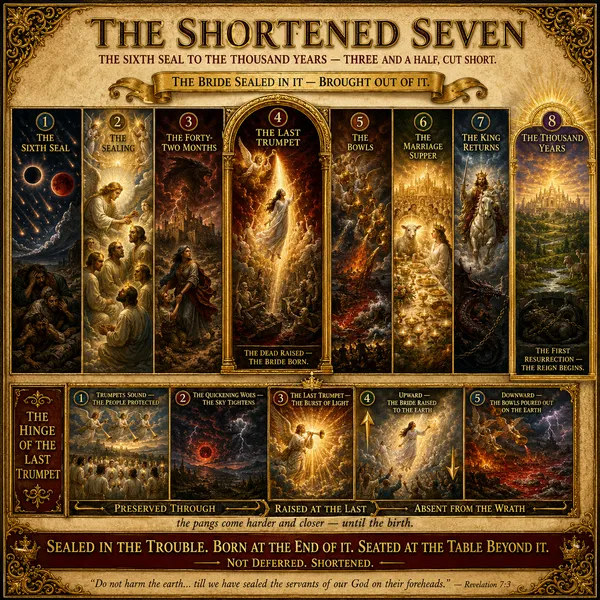
Between the sixth seal and the seventh, an angel calls out to the four winds: do not harm the earth or the sea or the trees, until we have sealed the servants of our God on their foreheads (Revelation 7:3). Then comes that famous number — 144,000, twelve thousand from each tribe. It is not a head count. It is a picture drawn in numbers: twelve times twelve times a thousand, the fullness of the tribes joined to the fullness of the apostles, multiplied until it overflows. We can tell it is a picture, because the moment John finishes hearing the number, he turns and looks — and sees something that cannot be counted at all: “a great multitude that no one could number, from every nation” (Revelation 7:9). It is one people, shown two ways: counted by tribe to mark whom they belong to, then seen beyond counting to show how many they are.
And these are the Bride — the one people God has been gathering to Himself across the ages: the believing remnant of the Jewish people, the scattered tribes of Israel coming home, and every believer from the nations brought near in Christ. The seal on her forehead is not an exit door. It is the blood on the doorpost. When God brought Israel out of Egypt, He did not carry them away before the plagues fell; He marked their homes with the blood of the lamb and kept them safe right in the middle of it, while judgment passed over. In the same way, the Bride is sealed for the trumpets, not removed before them — kept through the testing, not airlifted out of it.
Many sincere believers have been taught that the church will be quietly taken away before any of this begins. It is worth saying plainly, and kindly: that teaching is younger than most people realize. It was not taught by the apostles, and it was unknown to the church for its first eighteen centuries. When we go back to what Scripture actually says, the gathering of God’s people happens not before the trumpets but at the last of them — and three witnesses say so with one voice.
Paul: “We shall all be changed, in a moment… at the last trumpet” (1 Corinthians 15:51–52). Paul again: the Lord descends “with the trumpet call of God,” and the dead in Christ rise (1 Thessalonians 4:16–17). John: the seventh angel sounds his trumpet, and the kingdom is announced as the time for the dead arrives (Revelation 11:15). The seventh trumpet, the last trumpet, the trumpet of God — one sounding, three witnesses.
So the Bride is raised and gathered when that last trumpet sounds — and she is not there for the bowls. Those are the seven last plagues, the cup in which “the wrath of God is finished” (Revelation 15:1), and God’s people were never appointed to that wrath (1 Thessalonians 5:9). The trumpets are warnings, sounded over a world still being called to turn back. The bowls are the wrath that finally answers a world that will not. The Bride walks through the first under God’s seal, and is gathered home before the second is ever poured out.
Section VThe Woman, the Remnant, and the Homecoming
At the heart of Revelation stands a woman clothed with the sun, the moon under her feet, a crown of twelve stars on her head, and a dragon crouched to devour the Son she is about to bear (Revelation 12). She is not merely a symbol of the church in general. She is the living remnant of Israel, the covenant people in flesh and blood — the people out of whom the Messiah came and through whom the ancient promise has run. The dragon’s war against her is the long war against that people across all of history, and her shelter in the wilderness is the faithfulness of a God who will not let His remnant perish.
This matters, because the prophets promised a homecoming for that very people. Ezekiel saw a valley of dry bones come together, stand up, and live — and in that same vision he watched God take two sticks, one for Judah and one for Joseph, and join them into a single stick in His hand (Ezekiel 37). Zechariah saw the house of David look on the One they had pierced and weep (Zechariah 12:10). Paul wrote that “all Israel will be saved” when the full number of the nations has come in (Romans 11:25–27). That homecoming belongs to the sixth seal, and it is God’s own work, accomplished by His own Spirit — not something the church manufactures, not something a government declares, and not something the United Nations votes into being. Whatever weight the political events of the last century carry in the world’s history, the homecoming the prophets saw is something deeper and still to come: not a flag raised by human hands, but the natural branches looking on the One they pierced and being grafted back into their own tree — the olive tree of Romans 11, the cultivated tree of Israel into which believers from the nations have already been grafted.
Here it helps to be specific, because this is the very place the modern church most often takes an honest wrong turn. When most believers hear the word “Israel,” they picture only the Jewish people. The Jewish people truly are Israel — but they are not all of Israel. After Solomon, the nation tore in two. The southern kingdom was the house of Judah: the Jews, together with Benjamin and Levi. The northern kingdom was the house of Israel, often called Ephraim or Joseph after its leading tribe — ten tribes carried off by Assyria and scattered so far among the nations that the world forgot they were ever there. It was never only Jews who came out of Egypt; it was all twelve tribes, and a mixed multitude alongside them. And the 144,000 sealed in Revelation is counted from all the tribes, not from Judah alone — it is no more a company of Jews than it is a company of the sons of Joseph. In God’s reckoning Judah is not one inch more chosen than Joseph. They are two halves of one divided family, and His promise has always been to bring both of them home.
And so the Bride does two things at once. She never looks down on the natural branches — whether of Judah or of Joseph — for though they were broken off for unbelief, they are still loved for the sake of the fathers, and God is well able to graft them in again. But neither does she hand over her own place in Christ as though unbelief somehow outranked faith. The chosenness of Israel was never cancelled, and it was never handed off to some other people — it is fulfilled in Jesus, the promised Seed. And in Him the whole family is gathered into one: the believing remnant of Judah, the scattered house of Joseph coming home at last, and every stranger from the nations grafted in by faith — one tree, one Bride, one people of God.
Section VIThe Order God Set
The order is fixed, and we are not free to rearrange it: seals, then trumpets, then bowls. The Holy Spirit set that order, and no reader gets to fold its ends together or pour out the last cup before the first warning has even sounded. That means the next great event on God’s calendar is the sixth seal — the sun darkened, the moon like blood, the sky shaken, the powerful of the earth crying for the rocks to fall on them — not a silent disappearance of believers from their cars and kitchens. The age does not end with an escape. It ends with a shaking, and then with a wedding.
Within that order, the defeat of the enemy comes in two stages, and we must never mash them into one. At the cross, Satan’s legal authority was broken, his accusations silenced, his head crushed — and that is finished, beyond undoing. But his actual imprisonment, locked away in the abyss, is still to come (Revelation 20:1–3), and after it comes the thousand-year reign of Christ on the earth, which the Bible means as plainly as it says and which no clever reading should be allowed to evaporate into a metaphor. And if you ever wonder whether the age might have quietly ended already, Scripture has left markers in the ground that anyone can check.
| If the age had ended, this would already be true… | But Scripture says |
|---|---|
| Damascus would lie in ruins, no longer a city | Isaiah 17:1 |
| The graves would be empty, the dead already raised | John 5:28–29 |
| The nations would stream to Jerusalem to worship the King | Zechariah 14:16 |
| Death, the last enemy, would already be destroyed | 1 Corinthians 15:26 |
As long as Damascus is still a city, as long as the graves are still full, as long as death still has its way with us, the great consummation is still ahead — and an honest reader will not pretend otherwise. Those markers are a mercy. They guard us from being fooled by every voice that says “the Lord has already come and gone,” and they guard us from despair by promising that the day is fixed, and it is near.
Section VIIOath, Blood, Table, and Presence
Paul reminds us that the people of God were once strangers to “the covenants of promise” (Ephesians 2:12) — and there are three of them: God’s promise to Abraham, His covenant at Sinai, and the new covenant sealed in the blood of Jesus. They are not three rival arrangements but three movements of one story, crowned in Christ. Other covenants in Scripture each play their own part, but it is these three Covenants of Promise that carry the same four-fold truth, every time: a promise is sworn, blood is shed to seal it, a table is spread for fellowship, and the Presence of the One who made the promise comes to dwell with His people. The end of the age is simply that four-fold pattern brought at last to its fullness. The promise was sworn before the world began. The blood was shed once for all at the cross. The table is spread even now, every time we take the bread and the cup, and it is waiting to be filled to overflowing at the marriage supper of the Lamb. And the whole age, from the empty tomb until now, has been moving steadily toward one thing: the Presence of God with His people, face to face.
This is why we do not have to read the prophecy in fear, counting disasters to guess at a date — and why we do not need the false comfort of an escape hatch sprung before the storm. We read it ready: lamps trimmed, oil in the jar, eyes lifted to the horizon for the Bridegroom. The shakings will not undo us, because we are sealed. The wrath will not touch us, because we are gathered home before it falls. And the long night of the four horsemen will not break us, because we already know how the story ends. The age that opened at an empty tomb will close at a wedding feast — and the last word of the Bible is not a scream. It is an invitation.


Comments
No comments yet. Be the first.