The Question Behind
the Question
Week 1 of Covenant-Based Salvation — A 12-Week Walk Through the Greatest Love Story Ever Told
·
Section IThe Question We Were Handed
Walk into almost any evangelical church in the English-speaking world and you will hear a particular question hanging in the air, sometimes spoken, sometimes assumed: are you saved? The question shapes the altar call, the tract handed to a stranger at the airport, the conversation at the deathbed, the awkward exchange at a family reunion. It is the central question of Christian conversion as most of us have inherited it.
And it is real. Salvation matters. The Bible says so on almost every page. But the question, in the form we have inherited it, has hidden a deeper question underneath itself — a question the Bible asks first, and answers first, and never lets us escape. The deeper question is not are you saved. The deeper question is saved into what.
Almost no one asks this. Most of us were taught that salvation is a single event, a moment, a decision, a prayer prayed at a camp altar or in a hospital bed. You signed the card. You walked the aisle. You said the words. Heaven is now your destination. Your sins have been forgiven. Done.
That moment is real. We are not minimizing it. But Scripture itself describes salvation in language that does not stop at the moment. The Bible says we are saved into something. Saved into a Body. Saved into a Bride. Saved into a Kingdom. Saved into a Family. Saved into a covenant whose vows we have only begun to learn. The moment is the doorway. The much larger story is what waits on the other side.
Section IITwo Cultures, Two Pictures
The reason this matters — the reason we have to slow down before going further — is that the words we use shape what we expect. The English-speaking church inherited its core vocabulary from cultures that thought in transactional terms. The accountant culture. The lawyer culture. The contract culture. We talk about salvation the way we talk about a transaction at a bank: a debt was owed, a price was paid, the books are balanced, the receipt is filed. Done.
The Bible is not from that culture. The Bible was written by Hebrews, in Hebrew, under a Hebrew covenant. And in that culture, the language of salvation was not the language of transaction. It was the language of marriage.
Read carefully. Genesis to Revelation. The story moves like a wedding. God speaks vows. He chooses a Bride. He pays a bride-price. He builds a home. He prepares a feast. He returns. He claims His Bride forever. The accountant has been replaced by a Bridegroom. The transaction has been replaced by a covenant. The receipt has been replaced by a wedding ring.
If you have only ever seen the transactional picture, the wedding picture will stretch you. It is supposed to. The wedding picture is older. The wedding picture is what God Himself uses, on page after page, to describe what He has done with His people.
Section IIIThe Word the Bible Uses
The Bible's word for what God has done with His people is covenant.
Not contract. Not transaction. Covenant.
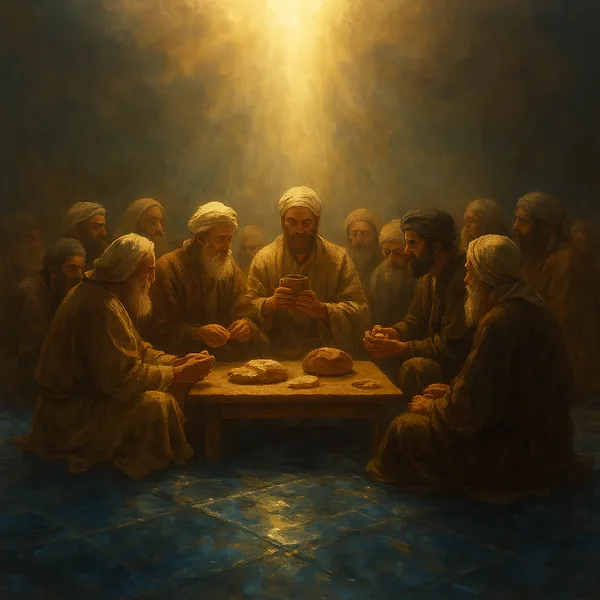
The Hebrew word is berit. It is one of the most important words in the entire Bible — used over three hundred times in the Old Testament alone. And once you see it, you will see covenant everywhere. The covenant with Adam. The covenant with Noah. The covenant with Abraham. The covenant at Sinai. The covenant with David. The promise of a New Covenant in Jeremiah and Ezekiel. The cup at the Last Supper — this cup is the new covenant in my blood. The Marriage Supper of the Lamb at the end of the Bible.
Every major movement of God in history is a covenant. Salvation is not a transaction; it is the entrance into the covenant the King of the universe has bound Himself to with His own blood.
Section IVOnce You See It, You Cannot Unsee It
That is the journey of these twelve weeks. We are going to walk slowly through what the Bible actually means by salvation, with the Hebrew word covenant as our compass. We will look at the wedding at Mount Sinai. We will look at the cup poured out in the upper room. We will look at the new heart promised by Ezekiel and given by the Holy Spirit. We will look forward to the wedding feast where the Bride finally meets her Bridegroom face to face.
And by the end, the question you started with — am I saved — will have grown into a much larger question, the one the Bible has been asking all along: am I in covenant.
This is what every believer is invited into. Not a transaction. Not a religious membership. Not a ticket to heaven. A covenant. A marriage. The deepest, most binding, most beautiful relationship offered to any human being.
Let the truth sit on your tongue. Let it sink in. You are not negotiating with a stranger. If you have come to Christ, you are speaking to the One who has covenanted Himself to you.
Salvation is not a transaction. It is a covenant — a marriage — the Bridegroom binding Himself to His Bride.
Covenant-Based Salvation · Ten Words Press
Section VScripture for the Week
Section VIA Practice for the Week
This week, every time you pray, begin with these words: Father, You are my God, and I am Your child.
Let the truth sit on your tongue. Let it sink in. You are not negotiating with a stranger. You are speaking to the One who has covenanted Himself to you. Notice what changes — in the prayer, in your posture, in your sense of who is on the other end of the conversation — when you begin every prayer with the language of covenant rather than the language of request.
Section VIIClosing Prayer
This is week 1 of a 12-week series adapted from Covenant-Based Salvation: A 12-Week Study for the Modern Church. The full book — including reflection questions, journaling space, four appendices, an expanded glossary, and a small-group leader's guide — is available on Amazon.


Comments
No comments yet. Be the first.