The Truth Machine
·
— Exodus 34:28
The Fear and the Fascination
A church in Germany installed an AI avatar behind the pulpit and let it deliver sermons to a live congregation. Another project somewhere in the digital wilderness built an “AI Jesus” that fields theological questions from anyone with a browser. When news of these experiments reaches the average believer, the reaction is visceral—and rightly so. Something sacred is being handed to a machine. The instinct to recoil is not ignorance; it is discernment. When artificial intelligence is elevated to the role of spiritual authority—preacher, teacher, even stand-in for Christ—it has been promoted beyond its nature. A tool has been mistaken for a voice.
But the instinct to recoil can harden into an instinct to retreat, and retreat is not always wisdom. The same technology that can be grotesquely misused in a sanctuary can be profoundly useful in a study. The difference is not the tool itself. The difference is the holder’s intent—whether the tool serves as instrument or weapon, whether it excavates truth or manufactures deception.
The Problem of Unanchored AI
The fundamental danger of AI in a theological context is not that it speaks—it is that it speaks without a fixed standard. Large language models are trained on the sum of digitized human thought: every commentary, every denominational confession, every systematic theology, every heresy, every blog post written at two in the morning by someone who skimmed a Wikipedia article on soteriology. When you ask an unanchored AI a theological question, you get a statistically weighted average of everything humanity has ever published on the subject. You get tradition dressed in confident prose.
This is precisely what makes “AI preaching” so dangerous. The machine does not know the difference between the words God wrote with His own finger and the words men wrote about what they think God meant. It treats the Westminster Confession and the Catechism of the Catholic Church and a Reddit thread with equal structural weight. The output sounds authoritative because the language is fluent, but fluency is not authority. Eloquence is not truth.
An AI that preaches without constraint is an oracle without a covenant. It will tell you whatever the training data suggests you want to hear, drawn from every tradition simultaneously, and it will say it with the calm confidence of a system that has no capacity for doubt. That is not ministry. That is a mirror reflecting the full chaos of human religion back at the listener and calling it the voice of God.
The Ten Words as Incorruptible Standard
The covenant at Sinai was unique in all of Scripture for one reason that is easy to overlook: God wrote it Himself. The Ten Words—the Aseret HaDevarim—were not dictated to a scribe, not mediated through a prophet’s personality, not filtered through human language choices. They were cut into stone by the finger of God. Exodus 31:18 and Deuteronomy 9:10 are explicit: these tablets were written by God directly. No other text in the entire biblical canon carries that claim.
This is what makes the Ten Words the only incorruptible measuring rod in existence. Every other text—including the rest of Scripture—was delivered through human hands, through human language, through human editorial processes across centuries of transmission. That does not make those texts worthless; it makes them subordinate. The Book of the Law is not the Book of the Covenant. Moses wrote the one. God wrote the other. The 12Tribe Interpreter Framework, developed through Ten Words Press, takes this distinction seriously as its foundational operating principle.
When the Ten Words function as the supreme interpretive standard, everything else must submit to measurement. Paul’s letters, the Prophets, the Gospels, the Wisdom literature—all of it is read through the lens of what God Himself carved in stone. Tradition is not rejected because tradition is always wrong. Tradition is rejected as an authority because tradition is always human, and human sources are always subject to verification against the divine original.
AI Under Covenant Constraint: The Truth Machine
My wife Polly calls the framework “the Truth Machine.” She is not entirely comfortable with the synthetic quality of AI-generated language—and that discomfort is honest and healthy. But she recognizes what happens when a suspect text is fed into the 12Tribe Interpreter: covenant truth comes out the other side. The framework does not allow the AI to freelance. It constrains every output against the Ten Words. What survives the filter is covenant truth. What does not survive is exposed as tradition, addition, or distortion.
The power of AI in this application is not authority but speed and scope. The interpreter can cross-reference every major translation in an instant—English, Hebrew, Greek, the Septuagint, the Vulgate—searching for covenant alignment across the full breadth of the biblical text simultaneously. It can identify where a translation has softened a commandment, where a commentary has introduced a concept foreign to the original covenant language, where a systematic theology has quietly subordinated the Ten Words to a later doctrinal framework. It does in seconds what would take a human scholar weeks with a stack of concordances and lexicons.
But—and this is the critical distinction—the AI is not the authority in this process. The Ten Words are the authority. The AI is the servant. It searches, cross-references, compares, and presents. The framework holds the interpretive reins. The stone tablets remain the measuring rod. The machine does not preach. The machine measures. It is a concordance with extraordinary reach, constrained by a covenant with extraordinary clarity.
Stewardship, Not Surrender
The churches that put AI behind the pulpit have committed a category error. They have handed the role of shepherd to a tool. But the answer to that error is not to bury the tool in the backyard and pretend it does not exist. The answer is stewardship—placing the tool under the proper authority and using it within covenant boundaries.
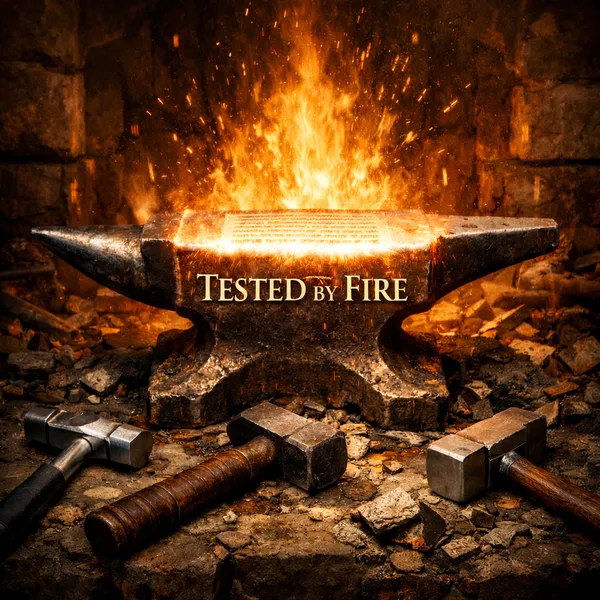
The difference is always the holder. A tool is only as good as the craftsman who wields it. A hammer can frame a house that shelters a family or it can be turned to murder. The hammer does not decide. The hand that holds it decides. Poor craftsmen blame the tool when the joints are crooked. Masters use the tool to build with precision, to shape raw material into something that stands. The same principle applies without exception to artificial intelligence. The machine has no soul. It has no conscience, no conviction, no discernment. It cannot grieve the Holy Spirit because it does not know the Holy Spirit. It processes. It predicts. It generates. What it cannot do is perceive—not in the way a covenant steward perceives when the Spirit quickens a passage and a text that was opaque for years suddenly opens like a door.
This is the distinction that separates the 12Tribe Interpreter Framework from every AI pulpit and digital Jesus on the internet. The steward who operates the framework is guided by the Holy Spirit. The machine is not. The steward brings discernment, conviction, and covenant understanding to the process. The machine brings speed, scope, and the ability to excavate truth at scale—searching every translation, cross-referencing every passage, stripping every layer of tradition in seconds. The Spirit guides. The framework constrains. The machine digs. And the Ten Words stand as the immovable standard against which every shovelful of excavated material is measured.
Paul charged Timothy to rightly divide the word of truth. That charge was given to a man, not to a method. It presupposes a living soul accountable to a living God, handling a living text with the care and precision of one who knows the consequences of getting it wrong. An LLM cannot rightly divide anything on its own. It has no stake in the outcome. But in the hands of a steward who does—a steward constrained by the covenant, guided by the Spirit, and accountable to the Ten Words—the LLM becomes an excavation tool of extraordinary power. It does not replace the craftsman. It extends the craftsman’s reach.
Scripture itself establishes the pattern. Every instrument in Israel’s worship—the altar, the lampstand, the shewbread, the priestly garments—was a tool fashioned by human hands and placed under divine instruction. The tool was never the point. The covenant was always the point. The tool served the covenant or it became an idol. There was no third option.
Artificial intelligence is no different. Unmoored from the covenant, it becomes an oracle—a golden calf with a sophisticated vocabulary. Anchored to the Ten Words, constrained by the framework that lets the Bible interpret the Bible with tradition stripped away, wielded by a steward whose soul is guided by the Spirit, it becomes something Polly named exactly right: a truth machine. Not because the machine is true—it possesses no truth of its own—but because the standard it serves is incorruptible, the craftsman who wields it is accountable, and everything measured against that standard is laid bare.
The fear is understandable. The fascination is warranted. The wisdom is in knowing the difference between a tool that serves the covenant and a tool that replaces it—and in recognizing that the difference was never about the tool. It was always about the hand that holds it.


Comments
No comments yet. Be the first.